Category: Articles

Articles

Festival of Britten. Peter Grimes. Opera North.

A tragedy of madness, hypocrisy, scapegoating and the claustrophobia of psychological repression. These elements were present with great force and deep impact on Saturday as Opera North opened its Festival of Britten with Peter Grimes. Such factors were to be found, of course, in the narrative; and in the chromatically shifting modal scheme with occasional shafts of bright, diatonic relief. However, the production design (Anthony Ward) in tandem with Phyllida Lloyd’s direction conveyed the same with oppressively bare austerity.

A large fishing net suspended from above and held open engulfed the chorus. Thus enclosed, ‘the borough’ were lent an amorphous mob identity at times devoid of individual difference. The local society surrounding the protagonist was to be seen as Grimes saw them. The repression imparted through Britten’s score compounded the up-tight, claustrophobic veneer of respectability that made this chorus in character a powderkeg. Where the net also tapped into the maritine context, the backdrop, which extended to the sides and corners of the set, depicted a greyish seascape, threatening with its blandness. An ingenious employment of duckboards allowed formal delineations to take shape when Aunty’s pub or the kangaroo court was in focus.

Jeffrey Lloyd-Roberts’ Grimes convinced of the complexity of the character with great verve. An analysis of his portrayal of Grimes in which acting performance and vocal proficiency are regarded separately would seem redundant: the two were seamless. It is an excellent casting. Here, his Grimes came across with an abiding innocence that is contorted into a false cynicism by the burning flames of lower middle class condemnation. The essence of this beleaguered purity was transmitted best by Lloyd-Roberts in Grimes’ aria ‘The Great Bear and Plaiedes’. Grimes’ desire to achieve great wealth and respectability was conveyed with that same innocence and false cynicism by the purity of  Lloyd-Roberts’ instrument. Such was compounded further by the apparent contrary nature of his frame, which is considerable. Laudable for its terrifying audacity was the moment when Grimes holds the dead apprentice aloft. Grime’s ‘mad scene’ was as disturbing as could have been intended. Lloyd-Roberts convinced of mental crisis. The pitfall resisted well was unintended comedy: no mean achievement.

High praise is due to Robert Hayward. His Captain Balstrode imparted measured maturity. His control and sonority – very exacting – conveyed the well-roundedness of the character to an impression of genuine masculinity. Where the character’s humanity toward Grimes amounted to the individual ability to think independently of a crowd, Hayward’s interpretation was a model of charisma.

Hypocritical, zealous accusation and gossip were at times comic in the interpretations of Mark Le Brocq (Bob Boles) and Rebecca de Pont Davies (Mrs. Sedley). Whether intended or not, these occasional forays into levity supplied a degree of relief and introduced an extra facet of the mundane with which to compare the overall tragedy. This lent perspective and threw light upon the degree to which apprently harmless gossip and rumour can be injurious.

Giselle Allen’s Ellen Orford spoke of great humanity both vocally and in acting performance. Maternal and uxorial profundity flooded the auditorium. From honeyed depths to heartfelt and deploring  resistence against castigation the impression was convincing. Perhaps Allen’s most engaging moment was during the Septet: on the repeated phrase ‘Hard hearts!’ I became swathed in a layer of goosebumps.Britten’s score was conveyed here, particularly by Allen, with upmost sense of tragedy. Indeed, all of the ensemble work, which is at times very difficult to execute with an overall aural impression of regulation, was a marvel of concerted spruceness. The piece ‘Old Joe has gone fishing’ was performed with an unexpected lightness. The temptation for the performer to oversing in this piece in order to mark separate passages rhythmically was not detectable.

The only negative, with the exceptions of Lloyd-Roberts and Hayward, was lapses in clarity of diction. Meaning was sometimes lost by principals and chorus. This was not an issue of balance. The opera is firm in the repertoire, but there will always be newcomers to an Opera North audience. One of their great strengths is the broadening of access to the tradition. Demanding, and, at times, counter-intuitive music such as this may result in such lapses. The danger for the newcomer to the audience is confusion in respect of the narrative. It might have been better to employ the televisual display screens used for the translations of non-English libretti.

The most irksome moment preceded choral catharsis. When mob rule ensues, imflamed by mounting gossip and rumour, raw savagery breaks out. In this production a very weird and well-crafted effigy of Grimes is brandished above the mob. Where the chorus reach their climax, the blood runs cold with apprehension. Moments of fine tenderness and vulnerability are experienced alongside such burning fury.
Articles

Simon Lindley (organ). Mill Hill Chapel. Leeds. Tuesday 14th…

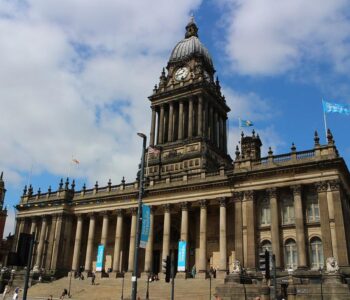
City Square is a curious mix of the old and the new. While Victorian patriarchs stand surrounded by lamp-brandishing, female nudes, a flock of seagulls ascends the building of what seems to be some sort of law firm. This is from a purely sculptural perspective. However, the visitor to Leeds might be forgiven for supposing that some of these statues come to life on Friday and Saturday nights. Standing with one’s back to Mill Hill Chapel the view is of the old post office. It seems to be a sort of fish restaurant now. Official formality has given way to greater leisure. The balance between these two forces was perfectly struck on Tuesday at Mill Hill Chapel. The graceful though severe Gothic arches of the fine, stained glass windows housed much warmth and mirth. Dr. Lindley reflected that it didn’t seem like a year since this series started previously. He put this impression down to “seniority”. It seemed that, to the amusement of many in the audience, they were able to empathise with this sentiment.

The effect of this organ is quite different to that of those in Leeds Minster and the town hall. Mill Hill Chapel is a much smaller building. The sound of the organ seems softer and somehow slightly muffled in comparison. In this acoustic the overall effect is one of relative modesty. This was quite charming.

We kicked off with Elgar’s Imperial March. Because there is virtually no decay to the sound in this space, the dynamic contrasts (between loud and quiet), both gradual and stark, were much more easily discernible. These were expertly sculpted through phrasing that saw descending flourishes and bright, brassy fanfares over the walking bass. The passages that were less march-like came across very jolly as an insoucient melody in a very synthetic sounding timbre jumped above ‘um-cha’ interplay. We were tantalised with the expectation of resolution as what’s known as a dominant pedal brought us to satisfaction. The overall sense of modesty made this a joyful rather than triumphal rendition.

Two pieces by Alec Rowley followed. The first – Benedictus – was based on a poem by Christina Rossetti. A hymn-like melody soothed above an undulating bass line. Here was much more variation between the different stops, and therefore pipes, than in the Elgar. Many different kinds of sound (timbre) were used as a result.

The second piece by Rowley – Heroic Suite – was in four parts. Heroic Postlude began sounding very angular because of the use of modes. Fanfares vied for domination with ascending flourishes here. This initial section was very arresting owing to the precision of the execution. It came back towards the close. sandwiching a quieter, more piano section that employed the normal (diatonic) scales. The second movement – Lament – saw a stern, oboe-like sound for the hopeful and yearning melody over a chordal accompaniment in a timbre that reminded me of the taste of ginger beer. Third from Rowley’s pen came Mood Fantasy. This began antiphonally with rapid, regular exchanges between treble and bass. The whole movement was very quiet and put across by Lindley with a very tender lightness of touch. The bass pedals seemed to steer the direction of the piece with economy. Finally came Triumph Song. This did what it said on the tin. It really woke us up with its rapidity, loudness and unexpected harmonic shifting.

Four Extemporisations, by Percy Whitlock, came next. The first – Carol – began in triple time with the melody in a flute-like timbre. This was underpinned by a descending bass in the pedals. Overall it was playful and nonchalant. Divertimento was, as Lindley described, “skittish”. A clarinet-like timbre saw a relentless, rapid running melody: very light. Harmonic stabs underpinned this in a soapy timbre.  This came back at the end, sandwiching a more reflective, slightly triumphal section. All was rhythmically spruce and finely sculpted. Fidelis was the title of the third movement, which was very meandering. Fanfare was the fourth. A trumpet-like timbre rang out as expected and descended several times in sequence. This piece confused the ear with surprising results because it  was chromatic and employed additive rhythm (bars of music of differing lengths one after another). Certainly here, and with the rest of the works performed, Lindley’s execution shone with brilliance. Possibly, this was due to the greater comparative intimacy of the venue.

Next came Sanctuary of the Heart by Albert Ketelby. Full of resonance and connotation, the piece was reminscent, at least melodically, of the sort thing one might associate with The Salvation Army. This in turn has a quality somewhat redolent of music hall songs. The highlight of the piece came when a throbbing triplet accompaniment, beautifully sculpted with the phrasing and dynamics, added a degree of drama. It was extremely moving.

The recital closed to a work from the pen of Liszt – although it sounded, in its complexity, like Bach. This, of course, was the intention. It was titled ‘Prelude and Fugue on BACH’. Here, the letters of ‘Bach’ are employed throughout as the names of the notes employed as the main theme (in German). This was astonishing. No written word can do the piece justice. I would suggest that the reader listens to it for him/herself. The performance conveyed Liszt’s homage with immense power through boldly measured execution. Mill Hill organ recitals continue on Tuesdays at 1.00pm. Payment is voluntary.

Articles

Phillip McCann (Cornet) & Simon Lindley (piano & organ).…

Brass instruments are associated with the brass bands of heavy industries, many of which have now disappeared. In many particular instances only the bands remain. Originally the brass bands were set up in association with collieries, factories etc. in order to divorce music from drink. A sober workforce was a more productive workforce. This paternal attitude can be felt to grate somewhat. Given this sentiment, there was a happy revelation on Monday lunchtime. Dr. Lindley reflected dryly on Phillip McCann’s fortitude in performing at that time. The colliery brass band that he directs had got through to the national finals the previous night. However, his performance at the town hall bore no traces of the Bacchanalia at which Lindley hinted. Indeed, it was an uplifting and refreshing treat.

A Hunsberger arrangement of Levy’s Grand Russian Fantasia was the musical greeting. Grandiose, Romantic chords on the piano full of very Russian, mediant shifts introduced the cornet. The liquid chrystal tone of the instrument was charming. In between the occasional, agitated piano interlude what sounded like a Russian dance was heard. McCann showed his mettle with great talent as the melody became more virtuosic and triple tonguing (rapid passages of short notes) was applied. Dynamic contrasts were subtle and the piece was finely balanced rhythmically. It was in the next piece that the tone and timbre of the instrument shone. Unfamiliar as I was with the individual sound of the cornet, what impressed most was  its humility and modesty compared with that of the trumpet. Both qualities were highly appropriate in Himes’s All that I am. We were moved to hear that the piece was composed by Himes on hearing that his wife had fallen ill. Profound sentiment was expressed, which taken with the context, spoke of duty. Following the depth of this piece came playful, light relief as Lindley performed solo Binge’s Miss Melanie on the organ. ‘Um-cha’ interplay underpinned a cheeky melody full of unexpected shifts.

A piece mimicking birdsong from the Thuringian forest came next by Hoch: Sing Vogelchen aus dem  Thuringerwald. Pleasing for the harmonic simplicity, well-balanced cornet trills followed melodic call and response where the response was muted – the birds in the forest were communicating ata distance. The piano accompaniment was highly varied – at times grand chords rang out only to be followed in other interludes with arpeggiated chords. An organ solo followed the birdsong – Howells’ Rhapsody IV in C. This sounded very angular and square harmonically because it was polytonal and modal. There was much impressive thrashing about by Lindley in this piece as he altered the organ stops and depressed the pedals. This was a sight to behold! The power of the town hall organ was shown off in the extreme here because the loudest stop was used. 

Then came a very familiar piece on the cornet with piano accompaniment: Aria con Variazioni. The well-known tune for this piece was that of the ‘Harmonious Blacksmith’. As the title suggests, the tune was repeated a  number of times but varied each time. This allowed McCann to show off again as the variations became more involved and rapid. A soothing, much slower organ solo composed by Sowerby followed to calm us all down.

A piece by Rance and arranged by Bulla came next: The Reason. With some jazz harmonies and in triple time the piece was higly reminiscent of a music hall song. Graceful passages on the cornet were supported with rhythmic spruceness on the piano. The Last Rose of Summer was the next offering, arranged by Hunsberger. This is a traditional Irish folk-song –  not the sort of thing I would usually associate with cornet and piano. However, here the modesty of the timbre was extremely effective in a very moving execution. Nevin’s Will O’ the Wisp was the organ solo that followed. A playful, light piece in which a rapid, running, continuous melody soothed and charmed in a flutey timbre. Typical of the programs at the town hall lunchtime concerts, this contrasted with the previous piece – you never get bored at these recitals. Lindley stayed put at the organ for the next cornet solo: The Old Rugged Cross by Bernard/Leidzen. This was a Salvation Army number. Funnily enough, again,  it sounded a lot like a musical hall song as with The Reason, which was also a Salvation Army song. Could there be a connection here?

With piano accompaniment the concert closed on Koenig’s Post Horn Galop. Here the cornet was dispensed with and a Post Horn was produced – a long, thin, metal tube reminiscent of a ‘yard of ale’. An extremely rapid, triple tonguing virtuoso display ended the concert with audacity.